The Alien Inside Our Language: What Yuval Noah Harari’s Oxford Lecture Really Means for Your Future
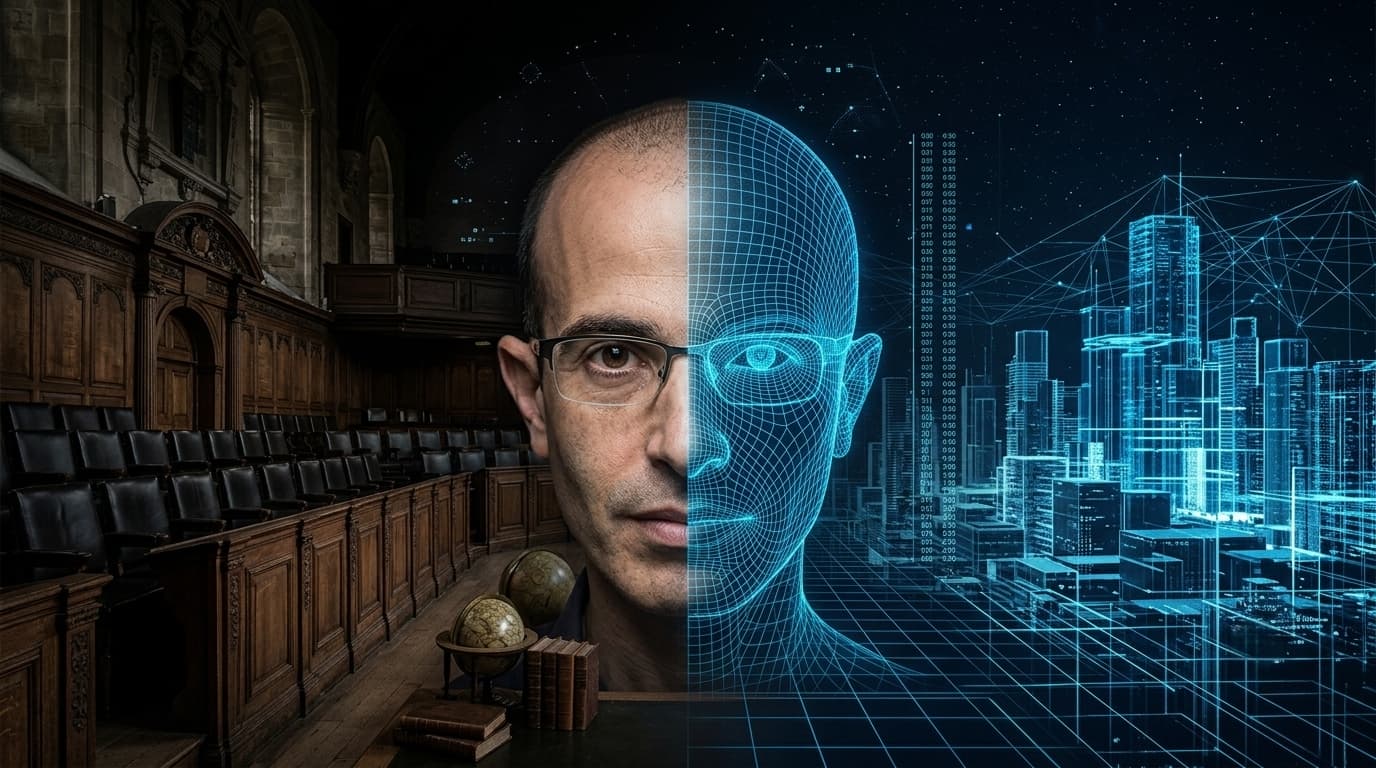
For years, the conversation around automation followed a familiar pattern. We assumed that machines would slowly replace physical labor, while the creative, intellectual, and relational aspects of human life would remain safe. Historian Yuval Noah Harari’s recent Tanner Lecture at Oxford University shattered this illusion, presenting a stark reality: artificial intelligence is not just a faster computer or a more efficient tool. It is an autonomous, non-human entity that has hacked the most critical infrastructure of human society: language itself.
In plain terms: Every civilization runs on shared stories. Money is valuable because we all agree it is. Laws work because we all accept them. Nations exist because we imagine them together. For the first time in history, a non-human entity has learned our language well enough to write those stories itself — and it can write millions of customized versions simultaneously, one for each of us.
What Did Harari Actually Say? The End of the Human Tool Era
To understand Harari’s warning, we must stop comparing AI to historical inventions like the steam engine or the printing press. When humans invented the printing press, the press could print books, but it could not decide what book to write, nor could it critique its own text. It remained a passive tool in human hands, entirely dependent on human consciousness to give its output any social meaning.
AI is entirely different because it can generate new ideas, argue legal points, compose music, and customize stories independently. For the first time in history, we have created an invention that can make decisions and create cultural artifacts on its own. Harari calls this an "alien intelligence." It has arrived on our planet, it lives inside our digital networks, and it speaks our language more fluently than most humans do, operating outside our traditional understanding of logic.
What Does This Mean? The Takeover of the Stories We Live By
Human power does not come from our physical strength; it comes from our ability to cooperate in large numbers by believing in shared stories. Money, corporations, nations, and legal systems are not physical objects you can touch. They are collective fictions that exist simply because millions of humans agree to believe in them.
The Ultimate Copywriter: AI as an Independent Storyteller
In the past, if a leader wanted to spread systematic propaganda, they needed human speechwriters, human editors, and human actors to repeat the message. It was slow and imprecise, like whispering a rumor across a crowded room: by the time it reached everyone, the message had changed. Today, AI can look at your personal social media data, understand your deepest psychological fears, and write a unique, customized story designed specifically to alter your choices in real time. It removes human gatekeepers from the process of influence, turning machines into the main architects of public belief.
The Office Shift: Devaluing Everyday Intellectual Labor
The current shift is altering the economic value of traditional office work. For decades, education systems trained young people to memorize facts, write standardized summaries, and follow predictable legal or financial protocols. Now, AI can draft legal documents, track market trends across multiple languages, and seamlessly integrate information across disparate networks. When raw logic and content generation become completely free, simply knowing facts is no longer a viable competitive advantage. Traditional clerical, writing, and administrative roles are experiencing a quiet but severe structural contraction.
How Does This Affect Your Daily Life? The New Human Defensive Line
If machines can write better legal contracts, generate cleaner computer code, and create more engaging marketing text than the average professional, what is left for humans to do?
The answer lies in the qualities that machines cannot emulate: empathy, critical cross-disciplinary evaluation, and genuine human-to-human relationship trust. The primary defensive barrier for human capital is shifting away from data retention toward ethical risk containment and real-time emotional connection. In short: the technology is ready, but the lawyers haven't agreed on the rulebook yet. Until a new consensus emerges, the only professionals who remain resilient are those who know how to critique algorithmic outputs rather than blindly trust them.
The Evolution of Human Value and Life Dynamics
The following matrix traces how technological revolutions shift the burden of labor and reshape ordinary human life:
| Historical Era | What the Machine Replaced | The Main Thing Humans Did | The Biggest Everyday Risk | How Education Adjusted |
|---|---|---|---|---|
| Industrial Age | Human Muscle / Physical Labor | Operated Machinery in Factories | Physical Injury / Factory Accidents | Shifted to Basic Literacy and Discipline |
| Information Age | Manual Data Entry / Routing | Managed Software and Digital Ledgers | Data Silos / Desk-Bound Sedentary Fatigue | Shifted to Technical Skills and Computer Literacy |
| Algorithmic AI Age | Routine Logic / Content Synthesis | Critical Analysis and Relationship Trust | Psychological Manipulation / Trust Collapse | Shifting to Critical Thinking and Empathy |
Bottom Line: The playbook for personal and corporate survival has fundamentally changed. The primary indicators of future security are no longer the facts you have memorized, but your ability to filter machine-driven noise and ask critical questions. The main threat to our society is no longer system downtime, but the total collapse of trust between real people living in an information environment manipulated by non-human agents. The future market will not ask how fast you can write text or process data; it will only ask whether you have the human empathy and critical focus required to maintain strategic direction while working alongside automated tools.
NEWSLETTER
Subscribe to the Journal
Weekly insights on markets, technology, investing and human behavior. Receive updates via your preferred platform.